Piave PDO: Alpine Cheese with Four Ages and a Distinctive Flavor
Story by Luke Pyenson · 508 readers
From creamy Fresco to nutty Vecchio, Piave PDO brings the Dolomites’ milk, grazing traditions and careful aging to the table.
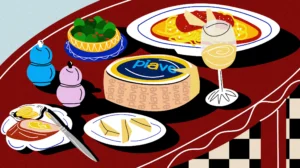
Piave PDO earns its place in the kitchen through quiet versatility. Young wheels melt smoothly into a panino; older ones add nutty, caramel notes to a cheese board or pasta. That range comes from a cheese closely tied to the land around Belluno, in Italy’s Veneto region, and to the farmers and dairy workers who make it there.

“It’s kind of like the best friend everyone leans on but never looks out for,” says Tess McNamara, Eataly North America’s director of fresh products. Her description captures Piave’s appeal: it supports a dish without taking it over. As interest in Dolomite food traditions grows, this cheese deserves a place in the conversation—and on the table.
A cheese shaped by its territory
The province of Belluno sits in northeastern Italy, a little over an hour north of Venice. The Piave River runs from the mountains through the Venetian Plain, past the Venetian Lagoon and toward the Adriatic. The cheese takes its name from that river, and its production is rooted in the surrounding area.
In Busche, the regional dairy cooperative Lattebusche has made Piave since its formation in 1954. It is the cheese’s sole producer. Piave received PDO status in 2010, after a decade of work to demonstrate that its character is distinct and bound to its place of production. Chiara Brandalise, director of the Consorzio Tutela Piave DOP, says the process required showing that the cheese was “unique and inimitable” because it is made in this territory.
The milk comes from cows of four permitted breeds: Bruna Italiana, Frisona Italiana, Pezzata Rossa and Grigio Alpina. Michela De Cet, a third-generation livestock breeder and dairy farmer near Busche, raises the first two. What the animals eat shapes the milk, she explains, and the area’s herbs and flowers contribute to Piave’s particular flavor.

Seasonal movement adds another layer. Like farmers in other Alpine cheese regions, local producers practice transhumance: cows move to higher pastures during part of the year and graze freely there. The milk changes with the season. Mountain milk, Brandalise says, contains more protein and has a different structure, which carries through into the finished cheese.

From pasture to four aging stages
De Cet’s is one of about 150 farms that supply milk to Lattebusche. At the cooperative, starter cultures—called fermenti in Italian—introduce local bacteria during cheesemaking. Brandalise compares this culture to a lievito madre, or sourdough starter. It’s one more way the cheese reflects its surroundings.
The milk mixture is cooked into curd, then pressed into wheels. Each wheel receives Piave’s distinctive logo at even intervals around its exterior, so the mark remains visible when the cheese is cut into portions. The design, which dates to the 1960s, sits alongside Lattebusche’s logo. McNamara likes the mid-century look, which recalls graphic work such as Walter Ballmer’s designs for Olivetti.
Color-coded labels identify four stages of maturity. Light blue marks Piave PDO Fresco, aged 20 to 60 days. Medium blue is Mezzano, aged 60 to 180 days. Dark blue identifies Vecchio, aged at least six months. Red marks Vecchio Selezione Oro, aged at least one year.
The differences make choosing a wheel a matter of matching age to use. Fresco and Mezzano are mild, creamy and floral, with sweet undertones. They pair well with local white wines such as Soave and melt readily in panini. For a simple, traditional preparation, sear the cheese in a frying pan and serve it with polenta. Brandalise describes the polenta as the side dish and the pan-cooked cheese as the main event.
What age brings to the plate
With time, Piave develops a more complex profile. Vecchio brings nutty and caramel notes, along with tyrosine crystals familiar from other aged cheeses. Yet it remains nuanced, even at its most mature. Let it come to room temperature to make those subtler flavors easier to appreciate.
Piave can be grated over pasta at any age, but its effect is measured. Instead of delivering a sharp burst of savory intensity, it settles into the dish’s underlying flavor. That restraint is useful when a recipe needs richness and depth without a dominant cheese flavor. McNamara says Piave has little “bravado”; she also considers it ready for the cheeseboard. The article describes it as affordable for shoppers and cheesemongers, even amid rising costs.
Restaurants make use of the same range. At Felix in Los Angeles, Evan Funke serves Piave with bigoli, the Venetian pasta, coated in duck ragù. At Manhattan’s Ci Siamo, Hillary Sterling pairs it with rabbit stracci. Stefano Secchi includes Piave Vecchio among the five cheeses in the cheese course at Rezdôra, his Emilia-Romagna-focused restaurant. Salads and other pasta dishes are also natural places for the cheese to contribute its quiet, savory character.
Keeping mountain cheesemaking alive
Piave’s future depends on more than its appeal at the counter. Mountain farming takes hard work, and Brandalise says younger generations may prefer less demanding occupations. McNamara points to the challenge of finding people willing to spend the May-to-October season in the Alps. That makes support for regional dairy farmers part of sustaining a tradition that cannot be separated from its place.
Changing conditions add pressure. During a July heat wave, De Cet said her cows were suffering in the heat: they produced less milk, ate poorly and faced a higher risk of miscarriage. Her farm has added fans, once an unthinkable measure, and is considering cooling sprinklers. Adaptations like these carry costs, and assistance for farmers is not assured.
De Cet’s work also extends beyond raising cows. She makes hay, cleans equipment and cares for the land. In her view, dairy farming helps maintain the character of the surrounding area. The production zone lies within Parco Nazionale Dolomiti Bellunesi, where environmental stewardship is a priority. The producers also take part in Carta d’Argento, a local quality and sustainability certification scheme with some similarities to the PDO program.
For home cooks, the practical takeaway is simple: choose the age that suits the dish. Reach for a younger Piave when you want a soft melt or a gentle, creamy flavor; choose Vecchio for a more developed note on pasta or a cheese board. Each wheel brings a particular patch of the Dolomites to the table—and keeping that flavor in circulation helps sustain the people and practices behind it.