At Ellen’s Stardust Diner, Singing Servers Pair Show Tunes With Times Square Service
Story by Grayson Samuels · 636 readers
At this Times Square diner, servers balance busy tables with live songs, reading the room while building their craft between shifts.
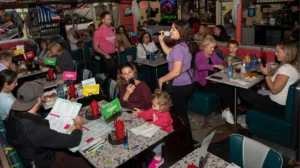
At Ellen’s Stardust Diner, a server might be carrying a tuna melt up the stairs when the next song begins. The work depends on two kinds of timing: keeping food and drinks moving through a packed Times Square dining room, and finding the right moment to step onto the catwalk and sing. That balancing act gives the diner its particular appeal—and makes the job a demanding one.
Keith White knows the split focus well. During one shift, table thirteen needs ketchup, table four’s fries are cooling, and a party of ten middle school choir students from Kansas City has just arrived, eager for Shirley Temples. White sends a waffle-cut fry reorder to the kitchen and drops off a bottle of Heinz. The drinks will have to wait; he has a song to sing.
“We have people ask for more ranch while you’re singing,” says White, whose favorite songs to perform include hits by Tears for Fears and Prince. He doesn’t currently sing musical theatre, a choice that can make him a welcome change of pace for dads who weren’t expecting a show-tunes restaurant.
Grayson Samuels reports on a dining room where hospitality and live performance share the same floor. Photos are by Clay Williams.

A diner built for a show
Ellen’s Stardust Diner opened in 1987, founded by Ellen Hart Sturm, who had held the title “Miss Subways” in 1959. That New York City pageant put contestants’ photos on train-car walls from Inwood to Brighton Beach. The restaurant nods to the era with neon, poodle skirts, sock hops and milkshakes, filtering its 1950s look through a lively, slightly outsized lens.
From 7 a.m. to midnight, servers move between booths and climb the stairs with meals in hand. The day starts with a full breakfast menu, and the singing begins early—sometimes before guests have finished their first coffee. On one visit, confetti cannons fired at 8:34 a.m.
Sean Doherty, an actor who started serving at Ellen’s a year ago, eases into those early sets. “We don’t want to start screaming ‘Defying Gravity’ at you first thing in the morning,” he says. He opens with “Younger Than Springtime” from South Pacific, using the classic ballad to warm up and check his range. A jazz standard may follow before he takes on the sustained high A at the end of “Santa Fe” from Newsies.
Bianca DiSarro, a server and emcee who has worked at Ellen’s between performing jobs since 2013, has changed her own approach to the morning. “When I was younger, I’d go to work and be like, ‘Let’s hit it running,’” she says. Now she takes time to prepare her voice, blowing bubbles, nebulizing and checking how it feels. Her first song is “Landslide” by Fleetwood Mac.
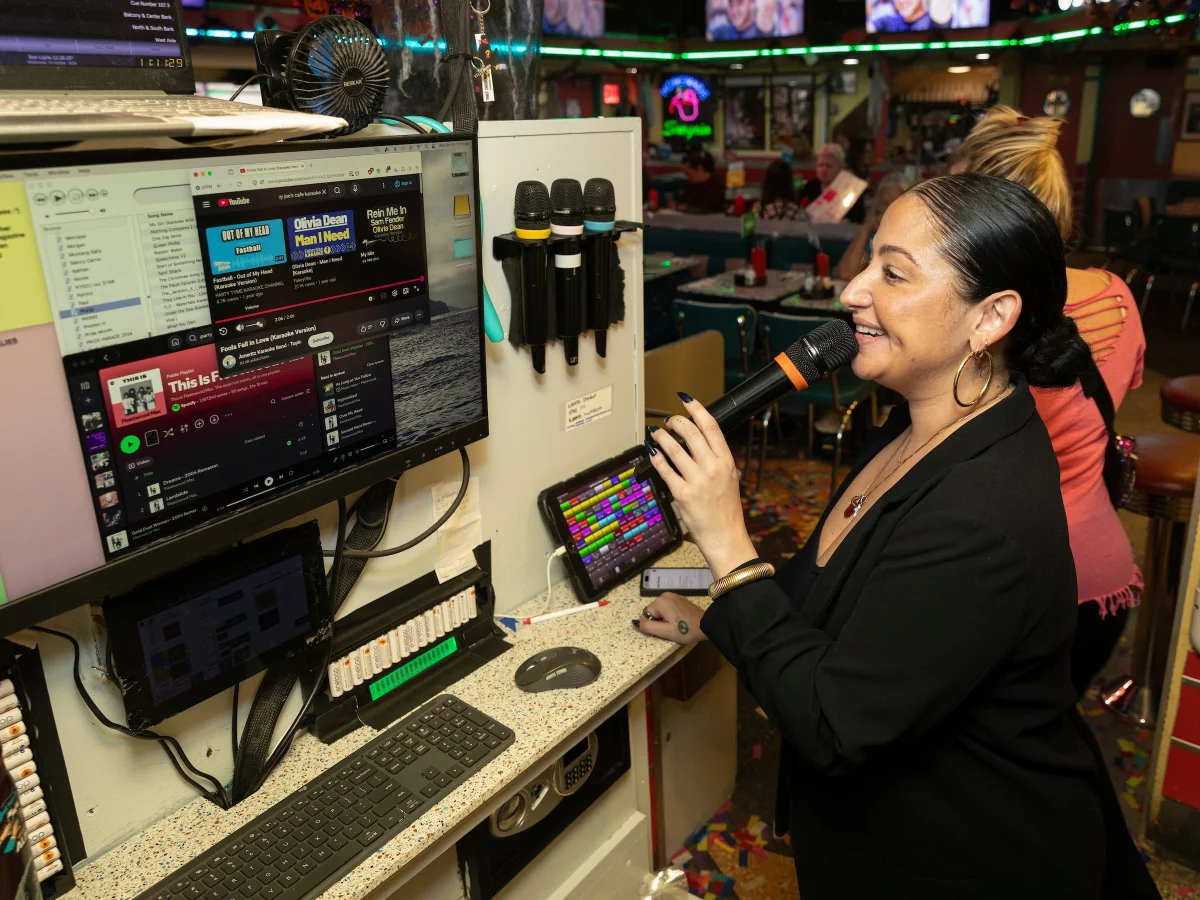
Bianca DiSarro curates the lineup as emcee.
Reading the room—and the running order
As emcee, DiSarro introduces each singer and song using a running order on a computer beside the bar. She tracks birthday celebrations and special requests, while leaving room to adjust the set to the people in front of her. Singers choose their own material: a soprano preparing a contemporary belt for an audition might try “So Much Better,” the Legally Blonde Act 1 finale; a baritone might close with the familiar “Soliloquy” from Carousel. Anything without curse words is fair game.
DiSarro prefers to make choices in the moment. “I always go on the vibe of the room and fly by the seat of my pants,” she says. Families and young children at a pre-matinee lunch may light up for “Let It Go.” Tourists who don’t speak English may respond more readily to “My Way” or “New York, New York.” Her years on the floor taught her to read those differences; when the emcee role was created more than a decade ago, she took it on, even though the pay was about the same.
The job also means keeping an eye on coworkers. If a server has just been seated with a party of eight, DiSarro can move their planned performance of the Dreamgirls number “And I Am Telling You I’m Not Going” later in the lineup. Singers may hear the updated order only as the shift unfolds, so a look or hand gesture can signal that someone needs a few more minutes to refill Diet Cokes. DiSarro knows the pressure from experience—and, if the whole team is swamped, she’ll step in to sing herself.
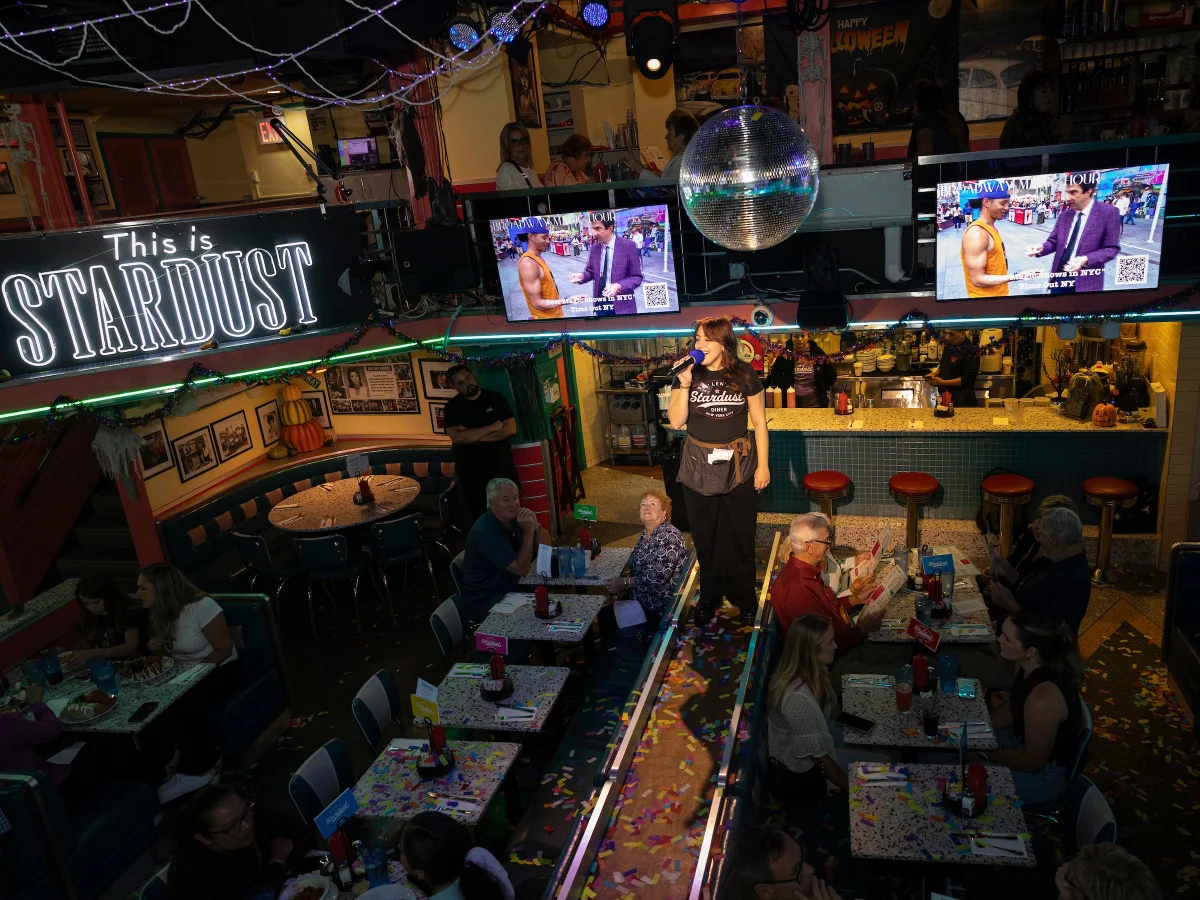
A catwalk between diner booths acts as center-stage.
That coordination matters because strong service and a strong set both take attention. Doherty sometimes wears special earplugs that block certain decibels, giving him relief from the constant overtures and bass-heavy music overhead. White treats a song as a brief break from the requests of the dining room. DiSarro keeps the stakes in perspective: “There’s no such thing as a cheeseburger emergency. Everyone will get fed, and everyone will hear me sing.”
More than dinner and a song
During the holiday rush, guests can line up along 51st Street toward 7th Avenue before the 7 a.m. opening. Waits average more than an hour, and the show is often the main attraction. Still, not every visitor arrives expecting a performance; some want the quick, familiar service they’d look for at any diner.
Live singing changes the relationship between guest and server. White says a performance can leave diners looking at a server with the kind of wonder they might show a magician. Doherty sees music as a way to reconnect with a difficult table: if something goes wrong with a meal, asking about a favorite song can open the door to a more personal exchange. For guests, the performance turns a routine meal into something direct and memorable.

The menu at Ellen’s features diner classics: pancakes, waffle fries, and piled-high burgers.
Getting a place on Ellen’s floor takes both restaurant experience and a prepared audition. Applicants need at least two years of high-volume serving experience in New York City. They then perform two contrasting songs for a panel; those who advance may face several rounds of callbacks. Even after passing, some wait months for a chance to join the floor. More than 100 servers are on the roster, with 15 working at a time.
Gayle’s Broadway Rose, an evening dining show at Friedman’s in Times Square, draws similarly competitive interest. Social media has helped raise the profile of both restaurants: videos of their singing servers attract millions of views, and each account has hundreds of thousands of followers. For performers seeking steady work and a wider audience, that visibility can matter.
“We have QR codes throughout the restaurant so people can look you up and see who you are and what you do,” says CR Sapp, a singing server at Gayle’s Broadway Rose. “We’re in the heart of Times Square, so it’s like you’re performing on Broadway.”
Mikako Martin, an actor who began serving at Gayle’s earlier this summer, sees the arrangement as unusually personal. Diners get close to performers, while actors find a visible stage between theater jobs. “They’re stoked that someone is singing to them and performing just for them,” she says. Doherty has seen young guests arrive with their families after being accepted to the University of Michigan for musical theatre. For aspiring performers, the meal can offer a glimpse of a working life built from persistence and many kinds of gigs.
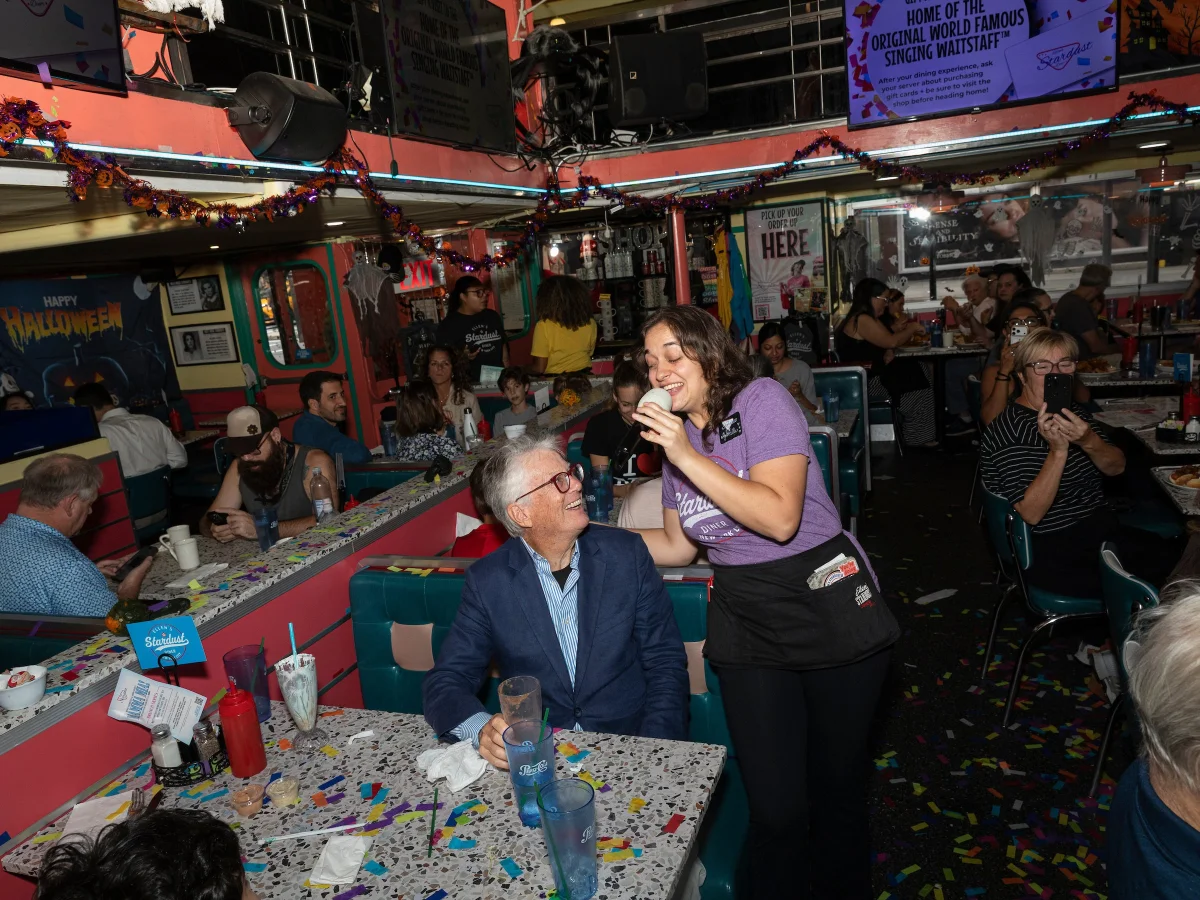
A singing server works the crowd.
Keeping the craft in practice
At Ellen’s, a donation bucket is passed through the restaurant every hour. The cash helps cover servers’ voice lessons and dance classes, expenses that can make a difference in a field where the talent pool keeps growing. White calls the work a grind, but says staying competitive means continuing to take classes. The effort has a visible history: a wide group of Ellen’s alumni now perform in Broadway and off-Broadway shows, including Titaníque creator and Tony nominee Marla Mindelle.
When the last guests leave, the dining room is left with straw wrappers, Subway maps, ketchup stains and confetti. The servers hang up their aprons and head home, often to prepare for another audition: headshots attached to résumés, fresh sheet music slipped into non-glare protectors. The shift may end at the diner, but for these performers, the next song is already taking shape.